28 jul 2014

Barcelona at your feet: pavement tiles (panots)

Barcelonins consider the floor tiles that cover most of the city streets one of their identity signs. Over the years, the interest in this humble pieces of the urban decor has increased. Now, their position as a symbol of Barcelona is well established.
Flor de Barcelona is the tile in the middle

You will find prints, t-shirts, chocolates, and all kind of gadgets bearing the "Flor de Barcelona panot". But this is not the only existing panot. In fact, it is said that 18 different tiles or panots cover the streets of Barcelona.

Some of these pavement tiles have been designed by top names in the architecture of Barcelona.

Flor de Barcelona is a design of Puig i Cadafalch

Or the Gaudí tiles that cover Passeig de Gràcia that, as you may have guessed, is made from a design of Antoni Gaudí.

    
If you want to buy a souvenir of Barcelona with a panot print, we suggest the following shops:


Panot Store (Carrer Banys Nous 20, very near Plaça del Pi): all kinds of lovely souvenirs with the Panot Flor de Barcelona print on them

Pastisseria Baylina (Passeig de Sant Joan near the corner with carrer Provença): chocolate panots

Bestiari inside the Centre Cultural Born: has some souvenirs bearing Panot de Barcelona and reproductions of the Gaudi pavement 


Gaudi pavement


Recovered pavement in Centre Cultural Born


For more details:

El Punt Avui on the Panot (Catalan)

Information on Panots published in La meva Barcelona (Catalan)


Article on Panots in Historia de Barcelona (Catalan)

22 jun 2014

My Top 5 Fake Barcelona

The saying goes "no es oro todo lo que reluce" and in Barcelona, as in any other town, there are monuments that visitors (and locals) considered to be "authentic" when they are just fakes. You are bound to see and take a picture of them as you stroll down the old town, so be aware!

Fake aqueduct remains
Real aqueduct remains
  • ROMAN AQUEDUCT: The remains of an aqueduct you can see next to Casa de l'Ardiaca in Plaça
    Nova were built during Franco's dictatorship (I have been said it was meant to be a compensation for the pains the city had endured during the war!). But don't be sad, if you want to see the real remains of the Roman aqueduct that brought water to Barcelona, you may see the remains of the original archs just a few meters ago from the fake ones. 
  • CATHEDRAL GOTHIC FAÇADE: The building of the Cathedral took many years, and it was not until the 20th century that funds were collected to built the façade. Manel Girona, a local banker, provided the funds and the façade was built following 19th century plans in neogothic style. But don't be disappointed, there are older parts in the Cathedral, check for instance Santa Llúcia's chapel. 
  • GENERALITAT GOTHIC BRIDGE crossing to Casa dels Canonges. Thousands of pictures are taken of this bridge, but it is not Gothic but Neogothic. The bridge was built in 1928 and it was strongly  criticised by Barcelonians of its time. Here is a very interesting article explaining the possible meaning of the skull in the bridge. Unfortunately, there is no English translation.
    Fake Gothic Bridge
  • ROSE WINDOW IN SANTA MARIA DEL MAR: in this case maybe it is too hard to consider it fake. The original rose window suffered serious damages in the earthquake of 1428 and, some years later, the new rose window was built. 
  • DISPLACED BUILDINGS: This is also a special case. The buildings are not fake, but they are not located where they originally were. In Plaça del Rei, for instance, is Casa Padellàs. It fits perfectly the surrounding buildings but, originally, it was were now is Via Laietana. When the avenue was built (in the 1930s), it was moved to its present location. Another building moved to a different location is Església de la Concepció, a worthwhile visit in the corner of Carrer Aragó with Carrer Roger de Llúria.

9 jun 2014

JAMÓN IN LAS RAMBLAS or HOW TO HAVE A DECENT BITE IN A TOURIST TRAP

If there is a fetish food to Spanish people, that is JAMÓN and, among the different varieties of JAMÓN, the king is JAMÓN DE JABUGO. So, if you want to learn about the culture of Spain, you
The bar in Jamon Experience: you don't have to take the tour to enjoy it
have to learn about Jamón.

For a foreigner, it may not be easy to tell the difference between Jamón varieties. You see that prices range from very affordable to incredibly expensive. Why? It is just a matter of the shop where I am buying the product?

Well, no. There is more science in the matter than that. Different pig species, breed systems, maturation of the meat and, even the way Jamón is cut have an influence on the quality (and price) of the product you are eating.

All this is explained in the tour of JAMÓN EXPERIENCE. For about 20 euros, the tour includes a detailed explanation, plus a taste of six different kinds of Jamón with a glass of cava, wine or beer. You may check for more details at their website: www.jamonexperience.com


From our point of view, it is even more interesting to visit their bar overlooking Las Ramblas. They are almost in front of La Boqueria and the bar is an outstanding balcony to see people going up and down the avenue while having a decent drink with some excellent food. Prices are quite acceptable for the area. Say you have a coca (flat bread) with Jamón ibérico de bellota: that is 5,90 euros. Add some olives (2,9 euros) and a glass of red wine (1,50 euros). Where in Las Ramblas would you find that quality at that price?  

26 may 2014

Having a beer in Barcelona: Salut!

Summer is approaching and temperatures are sky-rising. “Terrazas” are crowded with people. Many of them are there for just one thing: have a cold beer!
Estrella: the best selling brand in Barcelona

But having a beer in Barcelona (and, by extension, in Spain) has some little tricks and its own language.

First thing you must decide: Do you want a “cerveza” (beer) “de botella” (bottled) or “de barril” (vom Fass or draft beer)?

If you choose “de botella”, in a bar there are two main sizes: “mediana” (it is the most common size and is 33 cl.) or “quinto” (AKA “botellín”, it is smaller than mediana, 25 cl.). Some places may also have cans of beer but that is not common in bars or restaurants. Cans are more often sold on the street or on the beach by “lateros”. The choice there is only how much do you want to bargain over the price so there is little to talk about.

Next thing with “cerveza de botella” is to choose a brand. Best-selling brand in Barcelona is Estrella (a brand of manufacturer Damm). Similar beers are San Miguel or Mahou (which is far more common in Madrid). If you prefer foreign beers, most bars will have Heineken. Some may also have Mexican “Coronita” or “Sol”. Other brands may be more difficult to find in “common corner-bars”.

There is also a local beer called Moritz, which is quite good. And “cervezas artesanas” (made by small producers) are becoming more fashionable, Cervessa Montseny, for instance, is a very good one.

If you choose “cerveza de barril”, the main thing to think about is size, as there is a limited choice of brands in most bars (very often as limited as just one type of beer).

Smaller possible size is popular “caña” which is about 25 cl. Then, you may have “copa” in some bars (it’s bigger than “caña”) or “jarra”. “Copas” and “jarras” may also vary wildly in size depending on the bar. Most common size is half litre “jarras” (ask them by saying “una jarra de medio”) but in some places there are smaller jarras.

Other bars, specially the tourist traps in Las Ramblas, will directly serve one litre “jarras” as if it was the common size of beer in Spain. It is not. And if you don’t want to have as much beer, feel very comfortable to ask the waiter for a smaller size or complain.

If feel like drinking a less alcoholic mixture, you may try “una clara” (beer and lemon soft drink).


And finally, you may hear someone call “birra” to “cerveza”. If they are not Italian, remember “birra” is slang for “cerveza”.  

19 may 2014

LA BOQUERÍA MARKET: is there still something genuine there?

La Boqueria has deep roots in my mind. In my childhood memories, it is the market where I used to go shopping with my mother. As I grew old, and went to live alone, I went there on Saturday morning to buy the weekend's menu. 
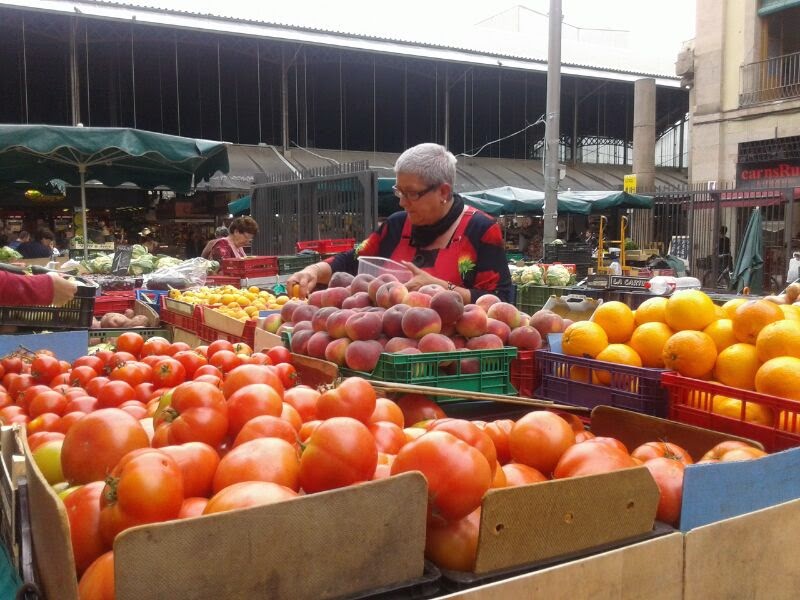
Parades de pageses


Over the years, it has changed, as Barcelona has changed. I guess it cannot be avoided and I have seen the same happen in many other touristic cities, but it is still painful. Why? Because "parades" are being replaced by "souvenir-selling stalls". The usual locals buying in the market are leaving the place, while crowds take photos. I don't think neither locals or visitors are winning with this change. Very soon, the tourists will miss in La Boqueria the experience they are looking for. Will La Boqueria "die out of success"? 

But I am not accepting defeat that easily. There must be still something genuine in La Boqueria. And here is what I have found: 


  • Parades de pageses: Farmers from the villages surrounding Barcelona come to the market to sell their products. There are no better artichokes, tomatos or salads in the market. You may find them in their modest stalls in Plaça Sant Galdric.

  • Carns Casanovas: It is near Plaça Sant Galdric. Casanovas is a big market stall with a long tradition. I buy my meat there. Is there a better recommendation?

  • Petras: when mushroom time arrives, Petras has a good choice of fresh product. When it is not the right time for fresh mushrooms, you may still find a good choice of dry ones. He used to sell eatable insects, until the sanitary authorities forbid it. 

  • Celler de la Boqueria: For wine shopping, I am particularly fond of their shop in Carrer Petxina, which is more calmed that its siblings in the market. The choice is not immense but I think it will cover most tastes. If you don't know what to buy, ask for advice, including the magic words "no quería gastar mucho" or "bueno, bonito y barato". 


  • Early hours: this is not a stall or a shop, it is a recommendation. If you want to have a feeling of "real Boqueria" go there early on a Saturday morning. 8.30 or 9 am are ok. By then, all the shops are already open but the tourist crowd has not yet arrived. Escape from the market "main street" and favour the side walks. 


I will not recommend anywhere to eat in the market. I think you may find the names of those places in most Tourist guides. I am not going to complain about their quality, but - in my opinion - the crowds of tourists willing to eat there and try "the genuine experience of market food" have little to do with the pleasant experience of market food on the spot. 


13 may 2014

BAR VELODROMO: Eating in Barcelona from 6 to 3 am

Some days ago, I was having coffee at Velódromo when the waitress commented on their opening times. Then I realised Velódromo is open and serves food at times when all Barcelona
seems to be sleeping. That is worth bearing in mind. It is not so easy to find a nice place, serving good food so late in the night (or early in the morning) in Barcelona. My informant says that if you go there near to its opening time, you can join the handsome night people in having a bite before going to sleep. According to him, they are people working in the surrounding clubs. My informant also says that Velódromo is a traditional bar recovered by Moritz when everybody feared it will be closed. It is lucky that we still have it. 


I don’t think Velódromo is on the classic tourist routes, but if your hotel is nearby or you happen to be strolling in the area, drop by and see. (I think Barcelona City Tour busses have a stop nearby, so if you are a user of this service …)

VELÓDROMO is in Carrer Muntaner 213 very near Av. Diagonal and is open 6 to 3 am, Monday to Sunday. 

Prices vary greatly on what you plan to eat. The place is not cheap, but you have the possibility to choose moderately priced dishes and keep the budget under control, while having tasty food. 

Here is another site’s comment on the place: http://www.bcnrestaurantes.com/barcelona.asp?restaurante=bar-velodromo

5 may 2014

My top 5 Barcelona souvenirs

El Traster
Maybe you are fond of tatty Flamencas or you think a Gaudi inspired toro is missing in your dining room. If you are like me, you probably like to have a little something from each of the places where you have been. But not anything goes. It must be something you can look at and remember the good times without feeling ashamed of having spent your money in creepy Chinese-made souvenirs.

If I were visiting Barcelona, I would buy these souvenirs:

-          A chocolate Barcelona pavement in Pastisseria Baylina (Passeig Sant Joan, almost in the corner with Carrer Provença, very near the Verdaguer Metro and in the way to Sagrada Familia). A similar and equally tasty option are the Gaudi chocolates boxes in Chocolatería Cacao Sampaka (in Carrer Consell de Cent, 292 very near Rambla de Catalunya).
-          A Barcelona Taxi reproduction in Kit-a-car (also in Passeig Sant Joan, but in the corner with Carrer Rosselló). It is a cheap and nice option. It is also a good present for kids. 
-          T-shirts in El Traster (a shop in Plaça Sant Agustí Vell and a good excuse to explore Barri de Sant Pere). T-shirts cost 12 €. They also have postcards, bags, knitted figures, and almost anything that's pretty and full of imagination).
Galeria Maxó
-          Galetes Trias Decorated biscuit boxes. This can be found in many shops. Among others, in El Corte Inglés. The biscuits are excellent and you can find an use for the box when the biscuits are over. 
-          Some piece of art in Galeria Maxó (in Portal Nou 29 also very near Plaça Sant Agustí Vell). Prices start at 22 euros for a small 3-D Barcelona door picture, so don't be afraid to go and see what they have. They are open every day from 11 to 21.30 h, so no excuse.